Early Bird and Last Minute Deals for trips to Arctic Alaska

We have some great deals for those of you who are still trying to choose the perfect Arctic Wild trip.

We are offering two last minutes specials at a 50% discount(!):

We have one extra seat in the plane for our Yukon River canoe trip in July. You can join the fun for only $1,150.

We also have space on our Arctic Coast Canoe trip June 28th to July 5th. Sign-up soon for only $2,050.

For the early birds, if you book a 2012 trip before July 1st, we will give you the current price:

So many of our trips for this summer are full that many are interested in reserving spots on our most popular trips like the Kokolik, Mission: Caribou, and the Kongakut River. We don’t have the exact dates for 2012 but the dates won’t change by more than a couple days. So if you want to make sure we have room for you and save some money too…Now is the time to sign-up for 2012.

Gray-Headed Chickadee

This June, Arctic Wild will be teaming up with Z-bird Tours for a rafting trip in the Western Brooks Range. Gray-headed chickadeeThe Kugururok River is a great raft trip for many reasons. Our main reason for the trip is to find North America’s hardest to see bird. Recent reports of Gray-headed Chickadees on the Kugururok river, combined with Arctic Wild’s expertise in wilderness travel, and Z-bird’s phenomenal birding abilities, will make this, a trip wilderness birders will be talking about for years.

Here is what Z-Bird’s owner and guide John Puschock has to say about why he is excited to return to the area to get another look a Gray-headed Chickadee.

” Of all the resident bird species in North America north of Mexico, the Gray-headed Chickadee (a.k.a. Siberian Tit) is arguably the most difficult bird to see.  It has a large range in the Old World, inhabiting boreal regions from Scandinavia to eastern Siberia.  In the New World it inhabits only Alaska, Yukon, and the Northwest Territories.  What makes it so difficult to see in North America is that there are almost no roads within its limited range, so just getting to where the birds are is an undertaking.Western Brooks Range, Kugururok RIver

The Gray-headed Chickadee’s preferred habitat is a bit of an enigma.  Various authors say it prefers spruce forest, others a mix of spruce and willow, or just willows.  Even in the Old World, it’s preferences vary from region to region.  In Alaska, it is usually found near isolated cottonwood (poplar) groves along a few north-slope rivers and in mixed scrub near tree-line in the Brooks Range  It’s a cavity nester, often nesting in poplars.
The Gray-headed Chickadee looks similar to Boreal Chickadee, but it’s bigger and has a larger white cheek patch and paler flanks.  The Boreal Chickadee probably evolved from the Gray-headed during the Pleistocene glaciations, and it’s thought that the current New World population is actually the result of the Gray-headed re-entering North America following glaciations.  Competition with the Boreal Chickadee may restrict its range.

Despite their close relationship, there’s no record of the two species hybridizing, which makes an encounter I had in 1998 all the more intriguing: The Kelly Bar on the Noatak River had for years, been the place to go to see the Gray-headed Chickadee, at least up until the mid-1990s.  I was banding birds in Northwest Alaska all summer and  I visited Kelly Bar intermittently.  With each visit I expected to see Gray-heads, but two frustrating months went by with no sightings.

Finally in August I spotted a chickadee with large white cheek patches.  “Finally”, I thought, but then I noticed that it was a colorful bird, as far as chickadees go.  It’s flanks were more like a Boreal Chickadee, with warm tones.  I froze and didn’t look for other field marks, such as white edging on the wing feathers (which would indicate Gray-headed).  I was just trying to comprehend what I was seeing.  And then all too quickly, the bird was gone.  I saw it for only 30 seconds. If I actually saw, what I think I saw, it could have been a hybrid.  But maybe it was a colorful Gray-headed, or a Boreal with more white in the cheek than normal, or maybe my eyes didn’t interpret things correctly.

After 12 years of pondering the brief encounter with the bird, it is time to return and take another look.”

Please join us in June for a fun filled birding adventure.


News from the North

There is much to report from Arctic Wild this March. Trips are filling and we are busy getting everything ready. I’ll write about all that soon. But for now, I want to recommend 2 articles from this weeks news, of interest to fellow arctic enthusiasts.

Out on the Northwest coast near Kotzebue researchers found scores of dead Musk ox encrusted in ice from a winter storm and tidal surge. I hate to imagine the scene. Read more here.

The other news is not so grim. Archeologists in Texas have discovered that Paleo-Indians arrived in North America thousands of years earlier than previously thought. This likely means that they migrated from Siberia not after the glacial maximum of the ice age, but during it! This will give me something to ponder on our Aleutians trip, which is along the likely route taken 15,000 years ago. Read more here.

Mission: Caribou

Mission: Caribou- Trip Report

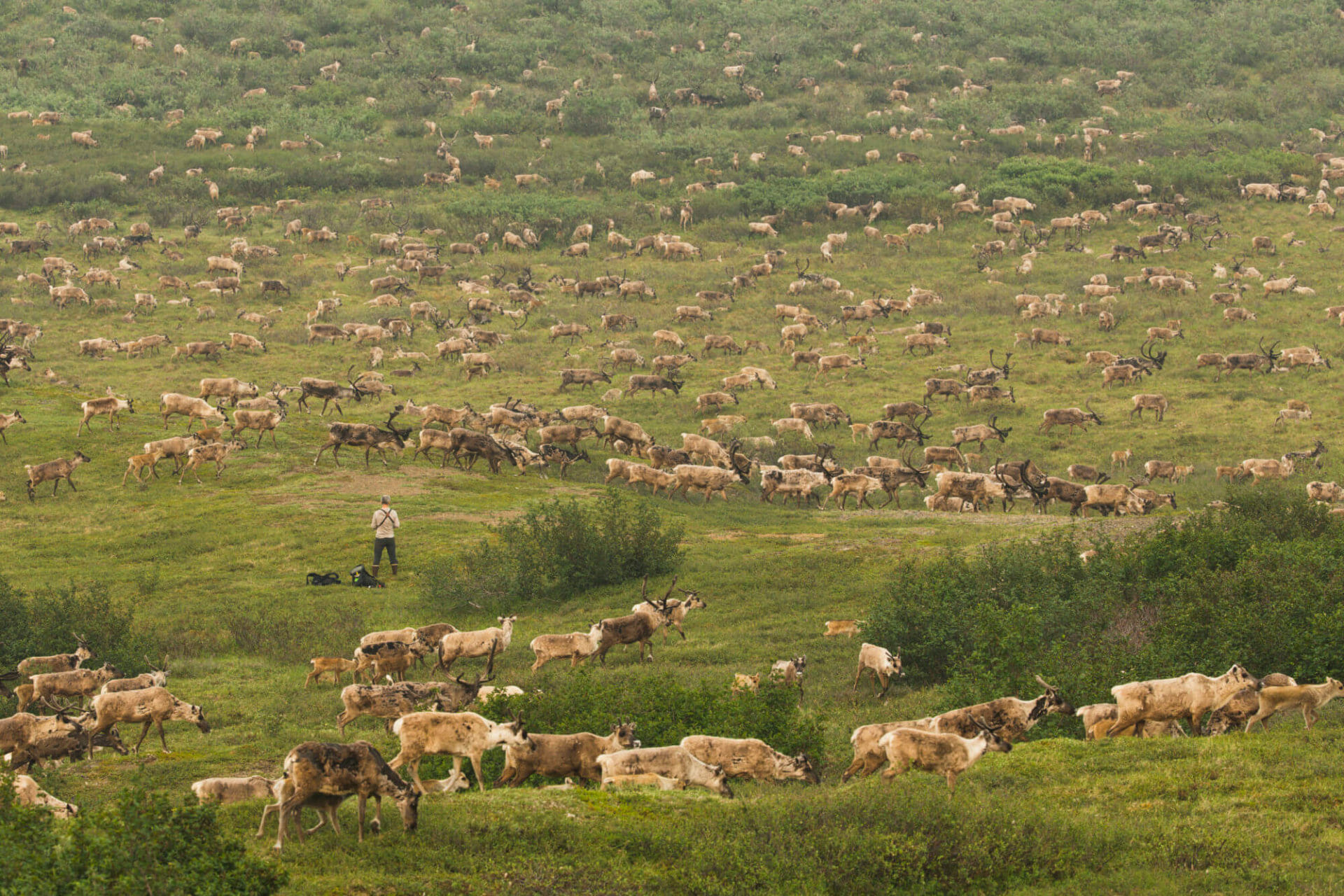
By Moe Witschard- Guide and Photographer www.moephotography.comCaribou cross an arctic river- Moe Witschard

Flying from Fairbanks in two Heliocouriers, small, but very sturdy bush planes that carried up to 3 people with all our gear, we arrived at the shore of the Beaufort Sea at 70 degrees latitude. We buzzed the area looking for a good camp and I chose a flat area next to Marsh Creek, about a mile from the ocean. Whooosh… minutes later we had landed, were unloading, and then setting up our most deluxe base camp with a huge cook tent that everyone enjoyed spending time in.  We proceeded to spend the last week of June at this camp watching early spring change to early summer.

Caribou in the Arctic Refuge

The number one goal of our Mission: Caribou trip was to closely and viscerally experience the magnificence of the Porcupine Caribou Herb migration, while base camping at a location within the Arctic National Wildlife Refuge. By communicating about herd movements with pilots and biologists right before the trip, we were able to drop ourselves right in front of a large west-moving mass of caribou, and all the other animals that move with and respond to the herd.

Each day, we stuffed day-packs with cameras, binoculars, warm clothes, and lots of yummy snacks and then set off in a different direction to hike, explore, and experience the tundra waking up and launching into a short, but furiously productive summer. Some days saw us hiking inland. Other days we hiked to the coast and walked the beaches for hours:  a grey cobble strip with tundra on one side and an ocean full of ice cubes on the other. Totally surreal! The family of four that I was guiding were from Tucson, Arizona. They wanted a vacation where they’d be out of their element. You could see it in their eyes that they’d gotten their wish as they marveled at the unique, humbling, and stunningly gorgeous landscape. Each day, we stopped for lunch at a spot that had firewood and we would build ourselves a nice fire to warm our bones as we replenished ourselves on gourmet bites before setting out to explore again.

Sea-ice in the Beaufort Sea Alaska

HIGHLIGHTS: Seeing thousands and thousands of caribou daily, sometimes right in camp; Seeing a wolverine traveling down the beach up to 100 yds. from us before seeing us and bolting ; The surreal landscape of the Beaufort Sea in early summer: sky, ice, and a little bit of water; Seeing a grizzly bear pass by our camp and move downwind of us until it smelled us and then getting to watch it run a distance of 2 miles in about 7 minutes; SO many different species of birds; Seeing the tundra vegetation come to life – at the start of the week, tiny willows starting to put out leaves. By the end of the week, they had gone to seed…and last but not least: not seeing any bugs until 5 pm on the day before we flew out, when all of a sudden it was summer, bugs were everywhere,  and we were all running for the insect repellent.

If experiencing the essence of caribou migration and the spirit of the Arctic coastal plain in early summer from a deluxe base camp sounds appealing, Mission: Caribou might be the trip.

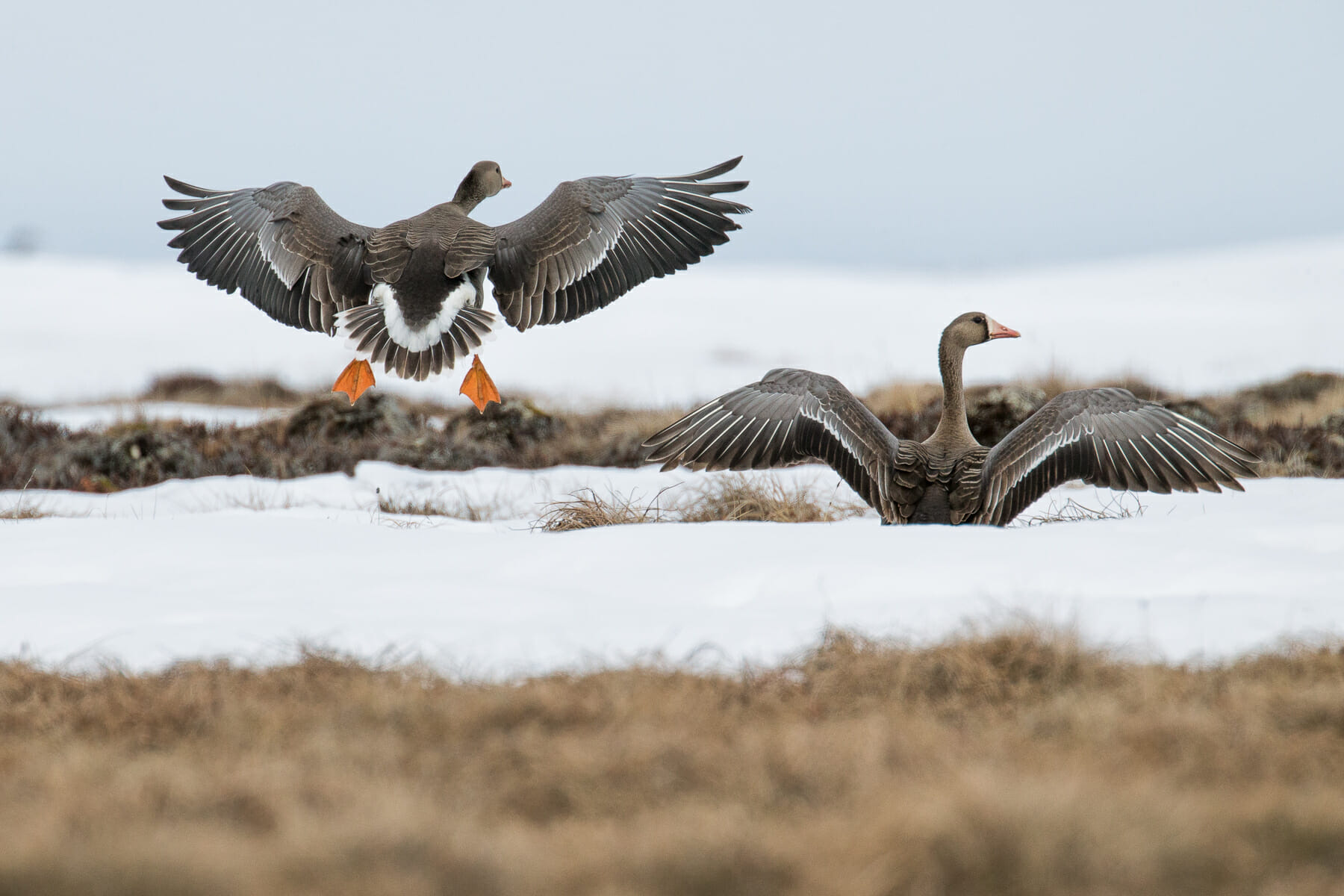
Swan picture from Arctic Alaska

Bears of the Katmai Coast

Trip Report by Michael Wald, Co-owner and guide.

I have to admit that the best trip ideas are rarely mine. Sometimes pilots suggest a new river or point out Katmai National Park Bear viewing tripan area I had never noticed. But very often clients will call me mid-winter and ask me to arrange a custom trip to a new location. I had dreamed of going to the Katmai Coast ever since I came to Alaska in 1991 but it wasn’t until last spring that I got to plan a trip to this remote and beautiful coast.  We were looking for great bear viewing but without so many bears that we couldn’t sleep peacefully. We wanted a variety of hiking, from the tundra, to glacier-covered mountains, to beach hiking, and we wanted a place where we were unlikely to see other people during our week in the wilds. After studying the maps and talking with Katmai National Park Tripfriends who have spent extensive time on the Katmai coast the location for a bear-viewing base camp became obvious. Not only did we get to see bears fighting, fishing, scavenging seal carcasses, and grazing placidly on the sedge meadows, but we were able to explore along the rocky headlands, peer into tide pools rich with sea-life, and hike inland to where the glacier pours down off the active volcano. The bears in Katmai are truly awesome and it takes some acclimation to get used to being around them constantly and having them nap near your camp. But these bears are not interested in people and they Bear viewing in Katmai National Parkgo about their lives as if we were no more significant than a gull (which we aren’t). Some of my favorite moments of the trip were in the evenings when we would get a campfire going and watch the tide recede. Predictably, at low tide our neighborhood bears (a sow with two half grown cubs) would saunter down to the beach and snuffle around in the sand  to see what the waves had dropped on their doorstep. Warmed by the fire, with a glacier-covered volcano in the distance we would watch the bears just being bears on the ragged Pacific coast. What more could we want after a day of tromping around on the tundra? Fresh- baked brownies anyone?

Winter Rains and Caribou

By Michael Wald Co-Owner and Guide

In late November, Alaska was pounded by a memorable storm. A great warm wave of rain swept north Winter in the Brooks Rangeacross the interior and all the way to the Arctic Coast. Once the rain passed, the temperature returned to a more seasonable -20 F, and in Fairbanks the rain on the cold roads made it possible to ice-skate right down the middle of the highway. School was canceled and nearly everyone was inconvenienced in some way. But how about up in the Brooks Range? I have been wondering how all that rain will affect the tundra. Did all the voles get soaked to the skin in the downpour and then freeze like so many vole-sickles? Did the rain create a crust of ice too thick for caribou or musk ox to dig through in search of forage? In 2005 we saw significant declines in musk ox in the Arctic Refuge and we are only now starting to see them again on trips like the Canning River. Many assume that musk ox declined because of a big icy storm in October of 2004. Will we see large die-offs of caribou this spring? Alaska Dispatch has an article about these very questions?

Right now all I can do is speculate. I am eager for our April trip to the Brooks Range to see for myself how this remarkable winter has etched itself into the landscape.

Guiding on Mars?

By Michael Wald Co-owner and GuideKobuk Sand Dunes

We don’t actually get to guide anyone on Mars but we have been working with some NASA funded scientist who are studying the Great Kobuk Sand Dunes in Kobuk Valley National Park. Apparently 10% of Mars is covered in sand dunes and scientist think the Kobuk Dunes are a good proxy to study what may be happening on Mars. If all the proposed projects get funded we will be spending several months in the dunes supporting scientific research in the coming years.

Here is what the Alaska Science Forum has to say about Martian research in Alaska:

By Ned Rozell
Alaska Science Forum

The Great Kobuk Sand Dunes are like Mars. Last March, guided by Alaska author and area resident Seth Kantner, Cynthia Dinwiddie of San Antonio traveled by snowmachine to the Great Kobuk Sand Dunes in northwest Alaska. Near Kobuk Valley National Park, she bunked for a few weeks at a cabin owned by Ambler resident Clarence Wood. The researcher from the Southwest Research Institute and a few of her colleagues dug several boreholes and pulled ground-penetrating radar sensors over the snow-covered dunes with snowmachines. The team sought to compare the unusual area with the surface of Mars. “Everything that this system represents you can find on Mars,” Dinwiddie said. “Dunes on Mars move slowly (due to winds) and so do dunes in the Kobuk Valley.” A surprise of the researchers’ visit was the discovery of unfrozen water beneath the dunes, at the base of the active layer (ground that freezes every winter, which in the dunes is from about four to 12 feet thick beneath the surface). “We found water everywhere,” Dinwiddie said.

Crossbills

By Co-owner and Guide Michael Wald

White-winged Crossbill in Alaska“What are all those birds?” my 4-year old, nature-geek son asks me as a small noisy cloud of birds descends and lands in the top of a Sitka Spruce. From the trilled call we can tell they are White-winged Crossbills. I’ve been spending a fair amount of time birding lately, and am getting excited for our birding trip on the Kugururok in June, but honestly I didn’t have much to tell my boy about them other than their name. So I came home and refreshed my memory on crossbills.

As you may expect, the end of their bills do indeed cross and they use this unusual bill for prying open conifer cones. Once they pry open the cone bracts, they extract the seed with their tongue and can eat an astonishing 3,000 seeds in a day. With this super efficient technique crossbills can thrive even during the deep cold of Alaska’s winter. Not only do they not fly south in search of food like so many other birds but they have also been known to breed in mid-winter when they encounter a bumper crop of seeds. Read more about these improbable boreal birds at Cornell’s excellent birding website.

Western Arctic Caribou: 400,000 strong.

By Co-Owner and Guide, Michael Wald

After a successful census it has been estimated that there are more than 400,000 caribou who make the Western Brooks Range their home.

Caribou in AlaskaThis is great news for those of us who get to travel to places like the Kokolik River, which annually treats paddlers to 30,000 caribou-days. On one trip we saw  both bears and wolves catching calves and watched tens of thousands of animal swim the river.

After several years of precipitous population declines in the mid- 2000′s  when the herd went from almost 500,000 down to 377,000, many of us became worried that the herd was going to wither. But in 2009 the Alaska Department of Fish and Game conducted an aerial census of the herd and confirmed that the population is stable. This means that caribou outnumber people 10 to 1 in the western arctic.

Wildlife on the Canning River

By Arctic Wild Guide: Michael Engelhard

Encounters with wildlife can feel like payback for karmic points earned and keep some of us buzzing for Polar Bears in Alaska's Arctic Refugedays. Perhaps more than in its weather or plants, the land’s life force concentrates in its creatures, sharpened to poignancy, similar but foreign enough to our own to be captivating. To some people, it becomes audible. A fellow wilderness guide describes it as a low frequency sound, “like a didgeridoo.” She has come to expect it in certain places and greets it like an old friend.

A fall day on a guided Canning River raft trip, at the western boundary of Alaska’s Arctic National Wildlife Refuge, will always remain special to the trip’s participants for what the land offered up.

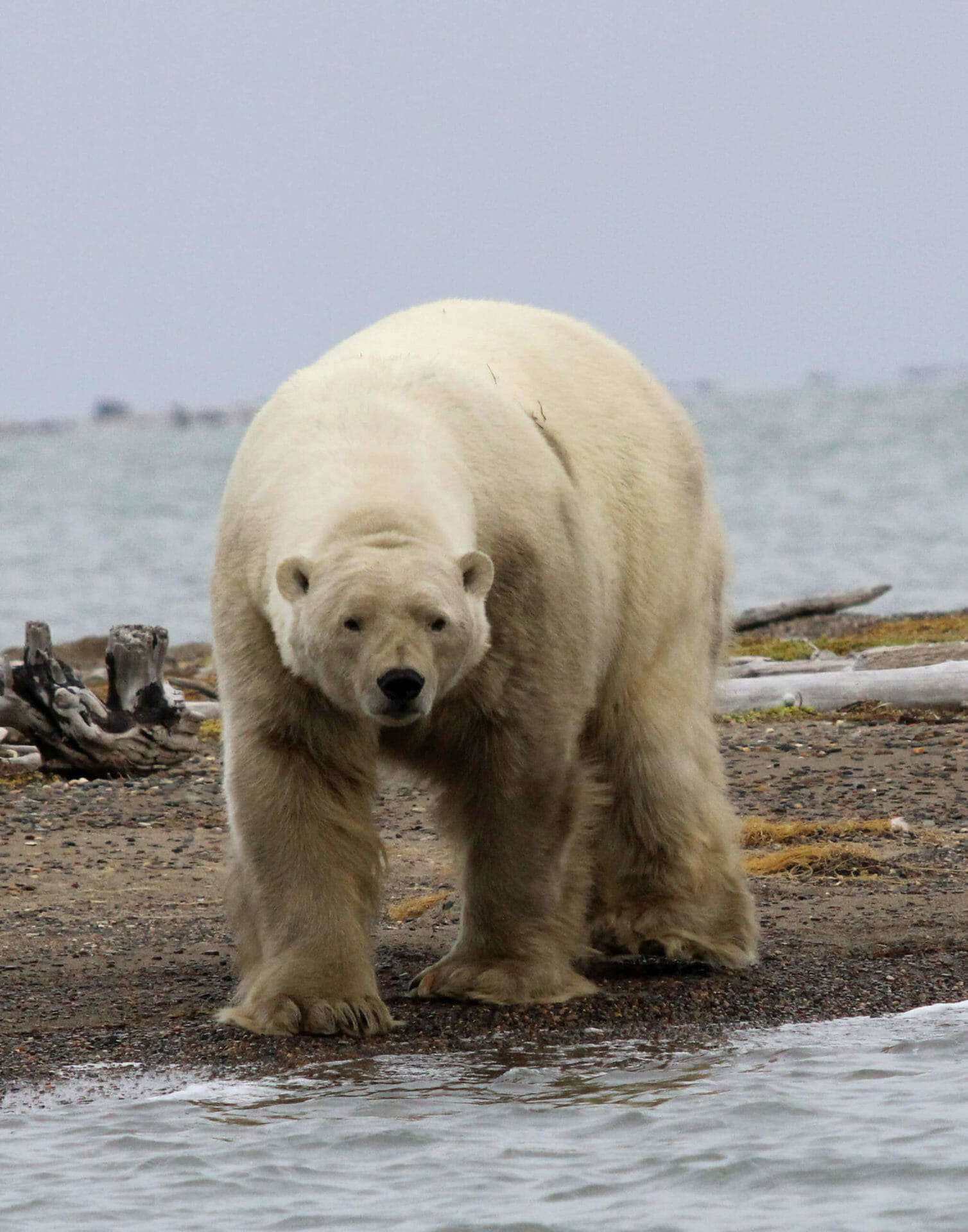
Sipping coffee in the morning’s quiet, looking south from the top of the bluff where we had pitched our tents, I noticed a white lump on the bench below muscling toward camp. A polar bear! The clients were quick to emerge from their nylon cocoons when I alerted them—one clad in boxer shorts and a down jacket. We stood and watched the bear sniff and root around. To this marine mammal-dependant carnivore (the largest on land), ground squirrels could have been the only morsels of interest there. Its wedge of a head swung on the pendulous neck, gauging god-knows-what. Thirty miles from the coast, radiant against willows and heather, the bear looked more displaced than it would have in a zoo. Sea ice—a haul-out for seals and hunting platform for the bears—had shrunk to the third-lowest extent on record. Hunger could have driven the bear this far inland, though it appeared healthy and fat.

Without a care in the world, it soon lay down for a nap halfway up the bluff’s slope.

Who was there to fear?

We sat and kept our binoculars trained on the pile that could easily have been mistaken for a smooth limestone boulder. Occasionally, the bear lifted its head to sample the air. We were downwind from it, and it remained unaware of our presence.

Before long, a golden eagle flapped past. Harassed by a mob of songbirds, it scrutinized the bear, which did not wake up. Then I caught another bright spot heading downstream. A cub? But the gait was different, a trotting more than an ambling. A scan with my glasses revealed a white wolf.

Animals congregating for no obvious reason leave us mystified and in awe, especially when they are rare. Arctic Fox near the Canning RiverThey embody connections we have lost, evoking lineages and ways of life that once were familiar but now seem arcane. At our layover camp, tracks of caribou, wolves, moose, bears, foxes, and a wolverine had seamed the mudflats with unknowable agendas. The day after, we had observed a peregrine making a kill, a black Arctic fox, and a moose built like a bulldozer—all within an hour. Animals even sought contact with us on occasion, mirroring our own curiosity: Mew gulls escorted the rafts, shrieking blue murder. Caribou stepped closer, eyeing us nervously. A red fox—nonnative like we and likely to cannibalize its smaller arctic cousins—investigated our dinner setup. The flow of animals in the continent’s margins clearly had changed. We had changed it.

Sure, there were explanations for such meetings, or at least the beginnings of explanations. Mornings and evenings, warm-blooded animals tend to be more active, avoiding mosquito peak times or heat, fueling up for a cold night or the day ahead. With their patchwork of habitats, rivers provide food and cover for prey and predators alike. Their corridors ease travel, funneling animals—and humans—from the boggy and lumpy tundra. Nevertheless, the landscape seemed lifeless for hours at a time and for miles around. We frequently surveyed it from a hilltop or standing up in the rafts, finding no movement except in the river’s slippage beneath scudding clouds. What fine-tuned the meanderings across this land? What tangled invisible paths at greater than random frequency? Did life attract more life, beyond caloric or reproductive rewards? Was there some animal magnetism, some orbiting of terrestrial bodies about which we knew nothing but which included us?

While shadowing the Porcupine caribou herd, the writer and wildlife biologist Karsten Heuer heard a Caribou in ANWR“guttural thrumming” at significant moments in the herd’s migration. Not much is known about this phenomenon, but Heuer believes it could be a key to understanding communication that orchestrates the herd’s moves and even transcends species boundaries. This strongly resonates with the beliefs of Gwich’in Indian hunters who, regarding caribou distant kin, have long claimed the ability to converse with them.

Unconcerned with such puzzles, the wolf approached the sleeping bear. Casting sideways glances and giving it a wide berth of respect, it then sauntered over a ridge, out of sight but already etched into memory.

Because the bear was not moving much and posed no immediate threat, I had breakfast and broke down my tent. Then I acted as lookout while the rest of our group took their turn and loaded the rafts, shielded by the bluff and prevailing wind. As I contemplated Sleeping Beauty with mild voyeuristic unease, I realized once again that, “out there,” who spots who first amounts to a matter of safety. Vision, hearing, and smell have been refined to various degrees in the tundra’s denizens to ensure survival of the most sentient. Enhanced by broad arctic vistas and a sparse natural soundtrack, this deep involvement of the senses accounts for the wilderness traveler’s sensation of being fully, if at times frightfully, alive.

As if to drive home that point, a camouflaged couple we’d run into below the Marsh Fork confluence came floating around the bend. Velvety caribou antlers in the raft’s bow attested to their prowess as hunters. But they drifted by with their bloody cargo, oblivious to the predator outside their field of vision that had just bumped them to a lower rank on the food chain. I shuddered to think how often I had courted disaster like unknowingly, like this.

When we shoved into the current a few hours after the initial sighting, the bear was up and moving again, sniffing through bushes on the bench. We stole away like thieves, enriched by an encounter that luckily stressed none of the parties involved.

Over the next fifteen miles, our course intersected with that of a northern harrier, a rough legged hawk, more peregrines, and low flying, yammering loons. An Arctic fox popped from between tussocks and then sat on its haunches with erect ears, intrigued by the bipedal transients.

Hours later, a tundra airstrip and a water flow gauge perched on a terrace on river right announced the end of our journey.

After a dinner upgraded by fresh grayling and char, I dumped dishwater down the cutbank, scattering ground squirrels that had staked out riverfront property by tunneling below the rim. Straightening up, I faced a grizzly nosing along the opposite shore. As we gathered to keep tabs on its progress, furtive movement on our side caught my eye. Some dark troll momentarily rose on its hind legs for a better view of us. Bear cub, my thoughts clicked into the familiar groove; but my fellow guide, Cyn, correctly identified the visitor: “It’s a wolverine!” Loping toward us on flat feet, the animal stopped repeatedly, as if considering a dare. This allowed us to check the bushy tail, burly legs, and brawler’s face characteristic of one of the North’s most elusive critters. I stared in disbelief until my eyes watered. This was only the second time I had seen the weasel on steroids, and the first time, in Denali, it had been a mere glimpse. At roughly a hundred yards, the wolverine hesitated. Deciding that it had crossed some kind of threshold, it bolted, jumped into the river, and dogpaddled to the other side. On shore, it shook its backlit coat, sending a burst of droplets flying. By then, the bear had lain down for an evening nap. The wolverine continued upstream where it spied the bear. Like its wolf counterpart before, it detoured around the sleeping mound. Then it clawed from the gravel bar up onto a bench and vanished behind a rise.

What a strange variation on a theme—like an Animal Planet rerun with a different cast. But to capture scenes like the ones we had witnessed in a single day, a documentary film crew would have to spend weeks or even months in the wilds.

Sunset had turned the northwestern horizon into a garish smear. A string of geese sailed right through it, Caribou in the Arctic National Wildlife Refugeblack cutouts pulled to their fall staging grounds near Beaufort Lagoon. The river shone gunmetal blue, braiding and unbraiding into its delta, beckoning us to carry on. Struck by oblique rays, icebergs glowed in the distance. The bear was still snoozing. When it got too dark to make out its shape, the clients crawled into their tents, trusting in our triage of pots and pans, pepper spray, and assorted firearms.

Before I turned in, the realities of our streamside world dissolved into those of another, one almost forgotten during the past week. To the north, near the coast, flares and red strobes ruptured the night like a mad carnival. The lights wavered and merged in the crystalline air. They spelled the undoing of everything we had experienced. They proclaimed the place where sanctuary yielded to busyness, where extraction passed for production. They hawked the stuff that became our gear and got us to the river—Prudhoe Bay crude.